



The Impact Plan
Transform your project planning with a powerful decision-making framework designed for industry professionals and academics. Gain clarity on the future impact of your creative endeavors while navigating challenges and prioritizing effectively.
Free shipping within the Netherlands
On orders of 20 euros and moreFast global delivery
Next day in NL, 1-5 business days in Europe and US, other countries ASAP
Product description
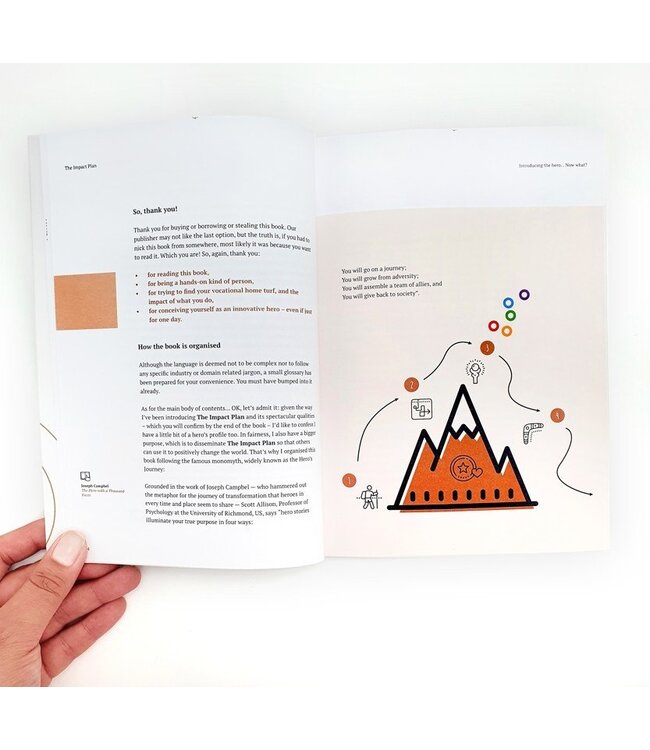
While formulated with designers in mind, the method elaborated within this book will help industry and academia professionals cycle through potential contexts and project influences in order to determine the impact these may have on both the individual and humanity. Moving through the fundamentals of decision-making and impact-centered thinking, The Impact Plan gives the reader a playful framework for planning and prioritising project-based activities and experiences.
Structured over four main sections which follow ‘The Hero’s Journey’, touching on introducing the journey, explaining adversities, deploying the tool, and reflection, moving through this framework will help drive the user to sharpen the craft of thinking. Balancing multiple contexts and providing room for personalization, this adaptable text will become the reader’s go-to impact-making tool when faced with a pool of different calls and possibilities.
Author
Catarina Lelis, Ph.D., is Senior Lecturer in Sciences and Technologies of Communication at the University of Aveiro, Portugal. She was the co-founder of a publishing start-up and of the Portuguese Association for Innovation and Creativity in Organisations. In 2013, she was awarded an Entrepreneurship Prize in Silicon Valley, US. She is the author of four design related software user manuals and has been published extensively for her work on dynamic visual identities, user/consumer experience, brand design, and impact-oriented ecologies.
Quote
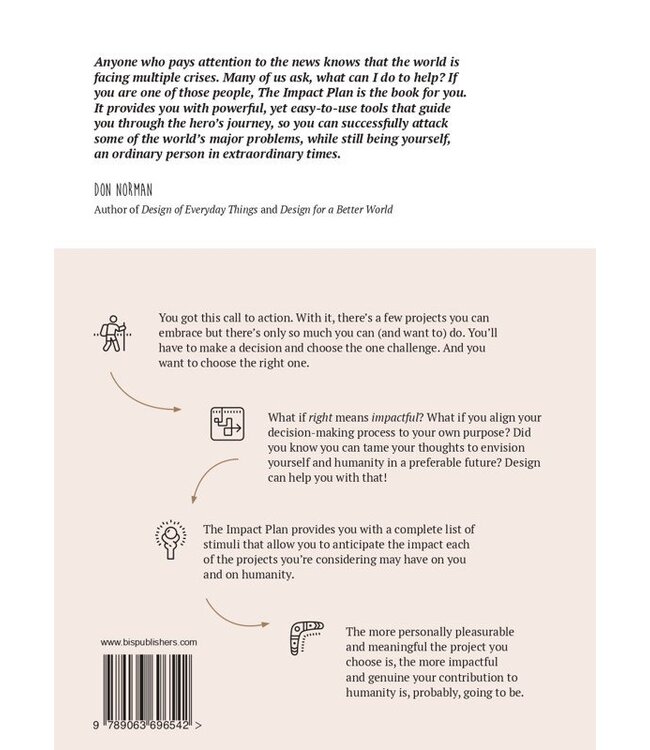
Anyone who pays attention to the news knows that the world is facing multiple crises. Many of us ask, what can I do to help? If you are one of those people, The Impact Plan is the book for you. It provides you with powerful, yet easy-to-use tools that guide you through the hero’s journey, so you can successfully attack some of the world’s major problems, while still being yourself, an ordinary person in extraordinary times.
Don Norman Professor Emeritus of Cognitive Science, director of The Design Lab at University of California, San Diego. Author of Design of Everyday Things and Design for a Better World (2023)
Reviews
I would say that The Impact Plan from Catarina Lelis is a must if you are a professor who needs to teach students about finding a purpose for their academic or industry projects. Moreover, the book might be considered philosophical thinking of anyone's life as a project. Being the hero (in Campbell's terms) who is looking for the common good is an ethical calling. Design-based thinking allows the hero to find purpose in the little significative things of everyday life; it is enough that those little things make our hero happy. Understanding happiness in an Aristotelian way, I would say this book is an ethical call for excellence.
"It's a Bird, It's a Plane, It's Superman!"
No, this book does not depict the story of the most famous super-hero the world as met but … it may help you be your own hero and have a purpose in society.
Catarina Lelis’ book packs a punch, offering readers a week's worth of entertainment, education, and inspiration. The author has created a thought-provoking narrative that centers on social impact, weaving in creative games, project planning, music, and visual prompts to keep readers engaged. The book is a must-read for anyone who wants to rethink their role in society and make a meaningful contribution to creating a more sustainable future.
Lelis' central argument is that we need to shift our approach to economic growth and development by creating value that benefits society as a whole, not just a select few. She offers a unique approach to project selection and decision-making, urging readers to evaluate the combination of risks, skills, and priorities with the potential for impact. This is a refreshing departure from the often-narrow focus on immediate gains and profits that can lead to short-sighted decision-making.
One of the book's key strengths is its emphasis on collaboration and partnership. Lelis recognizes that solving complex social and environmental problems requires the input and involvement of multiple stakeholders, including industry, government, and civil society. She advocates for creating networks of partners who can work together to design and implement sustainable solutions. This collaborative approach is essential for making meaningful progress toward a more sustainable and socially responsible future.
Another strength of the book is its focus on impact. Lelis argues that it is not enough to simply talk about sustainability and social responsibility; we need to be able to measure and communicate the impact of our actions. She offers practical tools and strategies for measuring and reporting on impact, including the use of metrics and storytelling. This focus on impact is critical for ensuring that our efforts are making a real difference in the world.
The book is written in a practical, accessible style that will appeal to a broad range of readers, from business entrepreneurs to researchers and undergraduate and postgraduate students. It offers a roadmap for aligning education, business, government, and civil society around a shared vision of sustainability and social responsibility.
In addition to its practical advice and guidance, the book is also a pleasure to read. Lelis' engaging writing style, combined with the creative games, good music and visual prompts, makes the book a fun and thought-provoking experience. Readers will come away from the book with a deeper understanding of their role in society and a renewed sense of purpose and inspiration.
Overall, this is an excellent book that offers readers a unique perspective on creating a more sustainable and socially responsible future. It is highly recommended for anyone who wants to make a difference in the world, whether they are professionals or students. By following Lelis' advice and guidance, readers can take meaningful steps toward a better future for themselves and for generations to come.
Overall, I enjoyed reading the book. It is well written with a nice and lively writing style that will appeal to many readers. I also found that the content is sufficiently framed by academic literature, industry directives and policy, yet remains easy to digest. This is a true strength of this book and allows its use inside and outside of academia. I think that postgraduate students will greatly benefit from its reflective approach.
Preview
Related products

Specifications
The Impact Plan
4 reviewsI would say that The Impact Plan from Catarina Lelis is a must if you are a professor who needs to teach students about finding a purpose for their academic or industry projects. Moreover, the book might be considered philosophical thinking of anyone's life as a project. Being the hero (in Campbell's terms) who is looking for the common good is an ethical calling. Design-based thinking allows the hero to find purpose in the little significative things of everyday life; it is enough that those little things make our hero happy. Understanding happiness in an Aristotelian way, I would say this book is an ethical call for excellence.
"It's a Bird, It's a Plane, It's Superman!"
No, this book does not depict the story of the most famous super-hero the world as met but … it may help you be your own hero and have a purpose in society.
Catarina Lelis’ book packs a punch, offering readers a week's worth of entertainment, education, and inspiration. The author has created a thought-provoking narrative that centers on social impact, weaving in creative games, project planning, music, and visual prompts to keep readers engaged. The book is a must-read for anyone who wants to rethink their role in society and make a meaningful contribution to creating a more sustainable future.
Lelis' central argument is that we need to shift our approach to economic growth and development by creating value that benefits society as a whole, not just a select few. She offers a unique approach to project selection and decision-making, urging readers to evaluate the combination of risks, skills, and priorities with the potential for impact. This is a refreshing departure from the often-narrow focus on immediate gains and profits that can lead to short-sighted decision-making.
One of the book's key strengths is its emphasis on collaboration and partnership. Lelis recognizes that solving complex social and environmental problems requires the input and involvement of multiple stakeholders, including industry, government, and civil society. She advocates for creating networks of partners who can work together to design and implement sustainable solutions. This collaborative approach is essential for making meaningful progress toward a more sustainable and socially responsible future.
Another strength of the book is its focus on impact. Lelis argues that it is not enough to simply talk about sustainability and social responsibility; we need to be able to measure and communicate the impact of our actions. She offers practical tools and strategies for measuring and reporting on impact, including the use of metrics and storytelling. This focus on impact is critical for ensuring that our efforts are making a real difference in the world.
The book is written in a practical, accessible style that will appeal to a broad range of readers, from business entrepreneurs to researchers and undergraduate and postgraduate students. It offers a roadmap for aligning education, business, government, and civil society around a shared vision of sustainability and social responsibility.
In addition to its practical advice and guidance, the book is also a pleasure to read. Lelis' engaging writing style, combined with the creative games, good music and visual prompts, makes the book a fun and thought-provoking experience. Readers will come away from the book with a deeper understanding of their role in society and a renewed sense of purpose and inspiration.
Overall, this is an excellent book that offers readers a unique perspective on creating a more sustainable and socially responsible future. It is highly recommended for anyone who wants to make a difference in the world, whether they are professionals or students. By following Lelis' advice and guidance, readers can take meaningful steps toward a better future for themselves and for generations to come.
Overall, I enjoyed reading the book. It is well written with a nice and lively writing style that will appeal to many readers. I also found that the content is sufficiently framed by academic literature, industry directives and policy, yet remains easy to digest. This is a true strength of this book and allows its use inside and outside of academia. I think that postgraduate students will greatly benefit from its reflective approach.
The book was exactly what I expected and more. After reading the book I knew how to create greater impact. I learnt how to anticipate by creating different future scenarios and turn overwhelming ideas into concrete step by step action-plan. Great guide to help for project management like myself or for any working professional.
Review Catarina Lelis The Impact Plan
Transform your project planning with a powerful decision-making framework designed for industry prof..


